4 min read

Six months ago, you got pulled into a cross-functional project. Your contribution was supposed to be advisory. But you started attending the weekly meetings. Then taking action items. Then managing dependencies. Nobody updated your role. But your role updated itself. Role creep and blurred boundaries at work don’t happen through failure. They happen through accommodation — so gradually that it doesn’t register as change. It registers as normal. This is the advanced stage of Silent Assignment™: not a single task transferred, but an entire boundary dissolved, one small accommodation at a time, until the original shape of your role is only visible to you — and only barely.
How Boundaries Soften
At first, everything feels defined. You know what you’re responsible for. Others know what they’re responsible for. Tasks have owners. Decisions have boundaries. Work has direction.
But frameworks don’t stay fixed. They bend — under pressure, under speed, under ambiguity. And when they bend, they don’t snap. They soften. A responsibility sits just outside someone’s role but close enough that they engage with it. Not fully — just enough to move it forward. Then it happens again. Each time, the boundary shifts slightly. Not enough to notice. Enough to matter.
Boundaries aren’t defined by documentation. They’re defined by behavior. What people actually do. And behavior changes faster than any organizational chart. The formal boundary says one thing. The behavioral boundary has been drifting for months. By the time those two versions diverge enough to be visible, the drift is already structural.
You’ve seen the specific version of this that happens over six months. You get pulled into a cross-functional project. Your contribution is supposed to be advisory. But you start attending the weekly meetings. Then you start taking action items. Then you’re managing dependencies. Nobody updated your role. But your role updated itself. Each step was a Silent Assignment™. None of them felt like a decision. Together they rewrote your position without a conversation.
Role creep and blurred boundaries at work don’t happen through failure. They happen through accommodation — and accommodation is invisible until the weight becomes unsustainable.
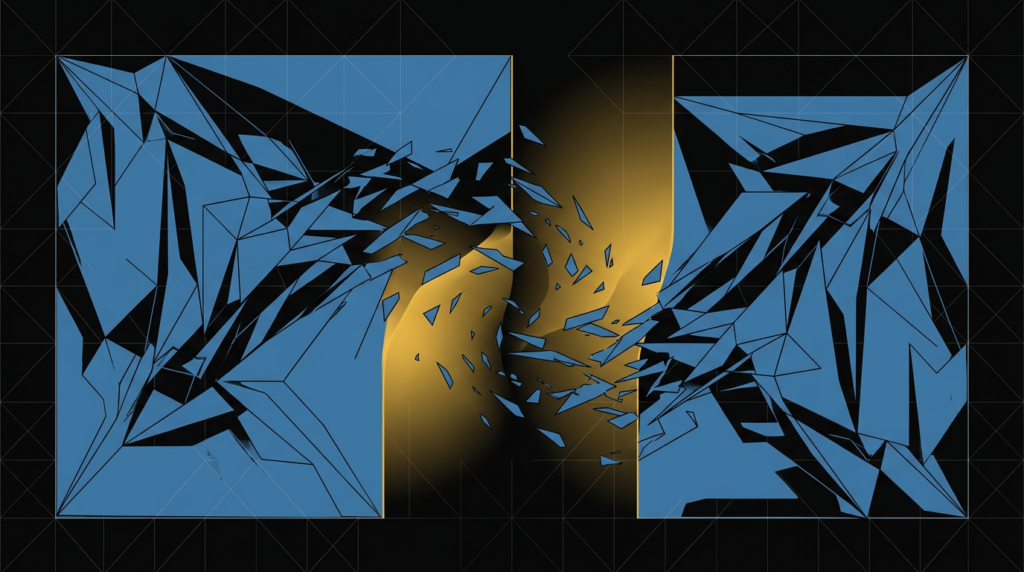
The Weight of Constant Interpretation
The effect of blur isn’t failure — it’s diffusion. Responsibility spreads rather than concentrates. And when it spreads, clarity weakens, because clarity depends on edges. Clear beginnings. Clear endings. Defined ownership.
When those edges soften, every interaction carries a question beneath it: Is this mine? That question doesn’t always have an answer. So you resolve it the fastest way possible — you take it. Not because it belongs to you. Because it’s easier than tracing the boundary, faster than clarifying the edge, safer than letting it sit. That resolution is another Silent Assignment™. Another layer added. Another degree of blur introduced.
Every time ambiguity appears and gets resolved through action, the blurred boundary stabilizes — not as a mistake, but as a new normal. Until something breaks. And when something breaks, the question surfaces: “Who owns this?” And the answer isn’t clear. Not because no one is capable. Because the boundary was never maintained. The Default Position™ forms not just for tasks but for entire domains — you become the person who handles everything in the blur, because you’ve been the one resolving it. Download the Urgency Reset Framework™ → HiddenCostOfSuccess.com/free/
↳ You’re not navigating unclear boundaries. You’re rebuilding them in real time — every day, with no blueprint and no support.
The Personal Weight
You’re lying in bed, mentally sorting which of tomorrow’s problems are actually yours. Some clearly are. Some clearly aren’t. Most live in the blur — the ambiguous zone where you’ll probably handle it because clarifying it takes more energy than just doing it.
That mental sorting is work. Unpaid, unrecognized, and constant. It’s the cognitive overhead of holding a boundary that nobody else is maintaining, in an operation that benefits from its absence. The Structural Debt™ doesn’t only show up in your task list — it shows up here, at 11 PM, in the invisible labor of interpretation. The roles around you blurred so gradually that nobody noticed they needed to be redrawn. Except you. And you noticed too late to fix it without a conversation nobody wants to have. Have it anyway. Before the blur becomes permanent.
WHAT TO DO WITH THIS If this feels familiar, you’re likely dealing with misallocated responsibility — not a time problem. You can start to see it more clearly using the Urgency Reset Framework™. Download the Urgency Reset Framework™ → HiddenCostOfSuccess.com/free/
Part of the mechanism: Responsibility Drift.