4 min read

Speed feels productive. You respond quickly. You decide quickly. You move things forward without hesitation. From the outside, it looks like clarity. From the inside, it feels like control. But making fast decisions under pressure mistakes is one of the most reliable dynamics in high-stakes environments — and it’s invisible to the person making them, because the speed itself feels like competence. What’s actually running is Pressure Diagnosis™ at the behavioral level: the fast, satisfying resolution that forecloses examination before the real picture forms — except this time it’s not a misread situation, it’s a misformed decision.
How Speed Reduces What Gets Examined
Every decision has a cost — not just in outcome, but in attention. What you include. What you exclude. What you evaluate before you act. Evaluation takes time. Not a lot. But enough to create a gap between input and response. That gap is where judgment forms. Remove the gap, and judgment compresses.
You don’t stop deciding. You decide faster — with less context, less comparison, less resistance. Speed simplifies not by improving clarity, but by reducing what’s examined. You start treating familiar as correct, immediate as necessary, available as sufficient. Those substitutions are subtle but they compound. Loudness Bias™ is operating at the decision level: the fastest-arriving option feels the most valid, not because it is, but because speed removes the friction that comparison requires.
You’ve caught yourself doing this. You replied to an email in thirty seconds and then spent thirty minutes cleaning up the misunderstanding the hasty reply created. The decision was fast. The correction cost ten times the original investment.
Making fast decisions under pressure mistakes happens because speed removes the friction that judgment needs. And without friction, everything feels equally valid.
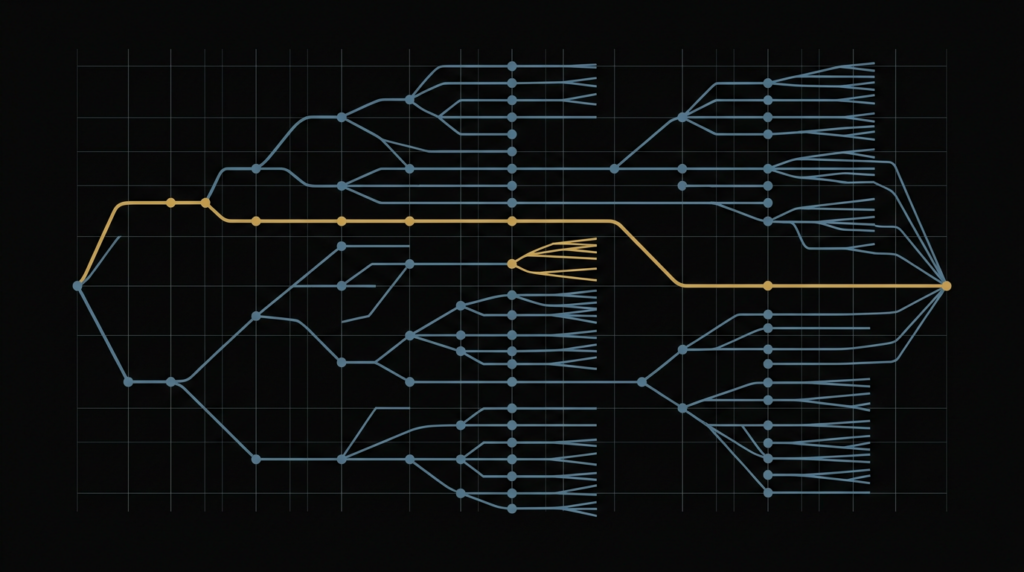
The Hidden Cost of Compressed Judgment
Fast decisions often feel right in the moment. They resolve tension. They clear uncertainty. They move things forward. But they don’t always move things correctly — because correctness requires friction. Slowing down enough to question assumptions, compare alternatives, recognize what isn’t immediately visible.
You can see this most clearly when decisions need to be revisited. Something gets handled quickly, moves forward, then comes back — not because it failed completely, but because it wasn’t fully understood. A detail was missed. A dependency wasn’t considered. An assumption went unexamined. So you re-engage and re-decide, which takes more time than the initial decision would have, had it been made with more space.
Fast decisions don’t eliminate work. They redistribute it — forward, into correction, into revision, into rework. The same issues returning. The same conversations repeating. The same decisions being revisited. Not because people are indecisive — because decisions were made before they were fully formed. The Urgency Loop™ ensures this repeats: fast response trains the environment to send more inputs at faster intervals, which compresses the next decision, which generates the next correction cycle. Speed creates the backlog it appears to be clearing. Download the Urgency Reset Framework™ → HiddenCostOfSuccess.com/free/
↳ The faster you move, the less you examine. The less you examine, the more you revisit. And revisiting is where the real cost accumulates.
The Inversion
Here’s what reverses the equation: the decisions that feel fastest are often the ones that cost the most in total time. The thirty-second decision that requires a three-day correction. The snap judgment that creates two weeks of downstream friction. The “quick call” that misaligns three people’s work for a month.
Speed feels like mastery. But mastery requires precision. And precision requires the one thing speed is designed to eliminate: the pause. The environments that reward speed the most are the environments where slowing down would produce the greatest return. And the leaders who resist that pause — because it feels inefficient, because it feels like hesitation, because it feels like the Urgency Loop™ demanding response — are the ones paying the highest cumulative price for decisions that were never given the space to be fully formed. The pause isn’t weakness. It’s the only tool that separates reaction from judgment.
WHAT TO DO WITH THIS If this feels familiar, you’re likely dealing with misallocated responsibility — not a time problem. You can start to see it more clearly using the Urgency Reset Framework™. Download the Urgency Reset Framework™ → HiddenCostOfSuccess.com/free/
Part of the mechanism: Urgency Drift.