5 min read

Someone said “I knew you’d get it done” last week. Instead of pride, you felt a quiet dread. Because you know what that sentence means: next time, they won’t even ask. They’ll assume. Being too reliable at work doesn’t produce burnout through overwork. It produces it through the Reliability Tax™ — the hidden cost extracted from those who are dependable, where every consistent delivery reconfigures the environment to send more, expect more, and depend more. Without anyone asking whether you can carry it. Without anyone noticing that asking stopped being necessary.
When Dependability Becomes a Tax
Reliability isn’t neutral. It changes how every operational environment around you behaves. The moment you become known as the person who delivers, the environment begins to adjust — not to reward you, but to utilize you. More gets routed your way. More gets expected. More gets assumed.
This doesn’t happen through a conversation. Nobody sits you down and says “because you’re reliable, we’re going to increase your load.” It happens through behavioral adaptation. You deliver consistently, so the environment starts treating your consistency as infrastructure. Your reliability becomes load-bearing — not for your own work, but for the operational gaps that nobody else is filling.
You’ve felt the specific version of this that lives in your body. The moment someone says “I knew you’d get it done” — and instead of pride, you feel a quiet dread. Because you know what that sentence actually means. It means next time, they won’t even ask. They’ll assume. That’s the Reliability Tax™ announcing itself: not through a demand, but through the quiet disappearance of any expectation that you might decline.
Being too reliable at work burnout doesn’t come from working hard. It comes from the environment treating your consistency as permission to send more — without ever asking whether you can carry it.
How the Environment Exploits Consistency
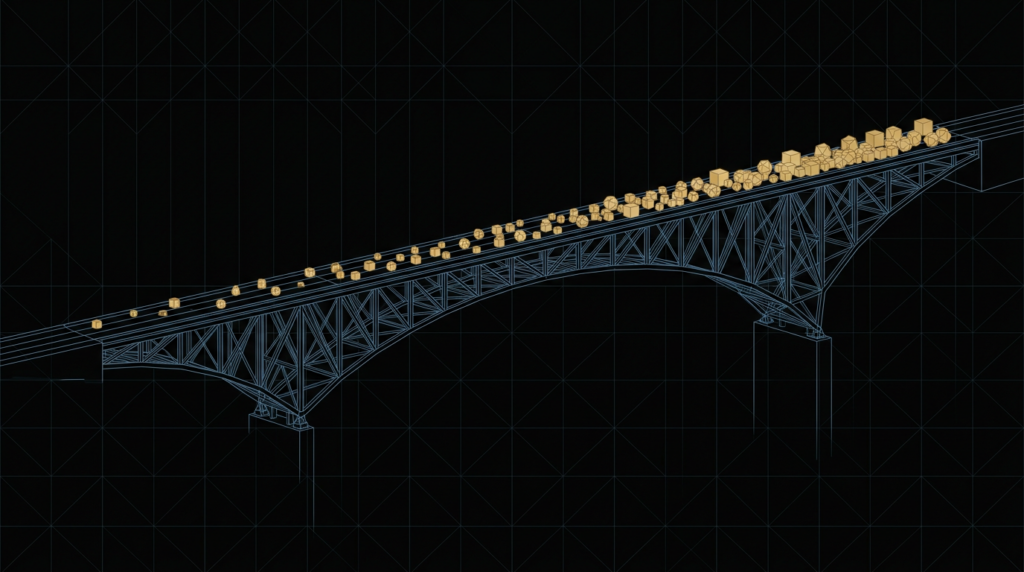
The mechanism runs in three stages. First, you demonstrate reliability. Second, the environment registers it as a routing preference. Third, that preference becomes default — and defaults don’t get re-evaluated.
Each stage builds silently. You deliver a project on time when others don’t. Now you’re the reliable one. You handle an ambiguous situation without drama. Now you’re the safe choice. You absorb extra work without complaint. Now you’re the available one. These aren’t promotions. They’re reclassifications. And each one increases the load without increasing the recognition, the compensation, or the support.
The compounding effect is what produces the burnout. Any individual task is manageable. The accumulated expectation is not. And the expectation is invisible — there’s no document that says “this person absorbs 40% more operational weight than their role requires.” There’s just behavior. Routing. Assumption. And the quiet understanding that you’ll handle it. The Reliability Tax™ doesn’t appear on any statement. It appears in the erosion: of energy, of margin, of the feeling that your capacity belongs to you rather than to whoever needs it next.
This is the same dynamic that quietly transfers ownership without anyone naming the transfer — Silent Assignment™ operating through character rather than circumstance.
Download the Urgency Reset Framework™ → HiddenCostOfSuccess.com/free/
↳ Your reliability isn’t being rewarded. It’s being consumed. And the difference between those two is the difference between a career that compounds and one that erodes.
The Weight You Feel at Night
The zoom-in is personal and precise. It’s 11 PM. You’re finishing something that could have waited until tomorrow — but you’re doing it tonight because you know that if you don’t, it won’t get done right. Not because your team is incompetent. Because the operation has stopped expecting anyone else to carry this particular weight. It’s yours. By default. By reputation. By the simple fact that you’ve never dropped it.
And lying in bed afterward, the thought isn’t “I worked too hard today.” The thought is: “If I stop being this reliable, what happens?” That question is the Reliability Tax™ at its most personal level — not the work itself, but the awareness that your value in this environment has become inseparable from your willingness to carry more than you should. The fear that putting anything down means becoming less essential. Less visible. Less you.
That identity didn’t come from nowhere. It was built by the environment, reinforced by every “I knew you’d get it done,” and is now held in place by your own reluctance to find out what happens if you stop. The tax isn’t just on your time. It’s on your sense of self. And that’s the version that doesn’t show up on any task list — but costs the most.
WHAT TO DO WITH THIS If this feels familiar, you’re likely dealing with misallocated responsibility — not a time problem. You can start to see it more clearly using the Urgency Reset Framework™.
Download the Urgency Reset Framework™ → HiddenCostOfSuccess.com/free/
Next in this series: The Problem Isn’t Time →
Part of the mechanism: Responsibility Drift.