The Operator’s Dashboard™
The quarterly maintenance instrument that scores how your time and responsibility are drifting — so the overload you cleared doesn’t silently rebuild. Included with the Operator’s Stack — not sold on its own.
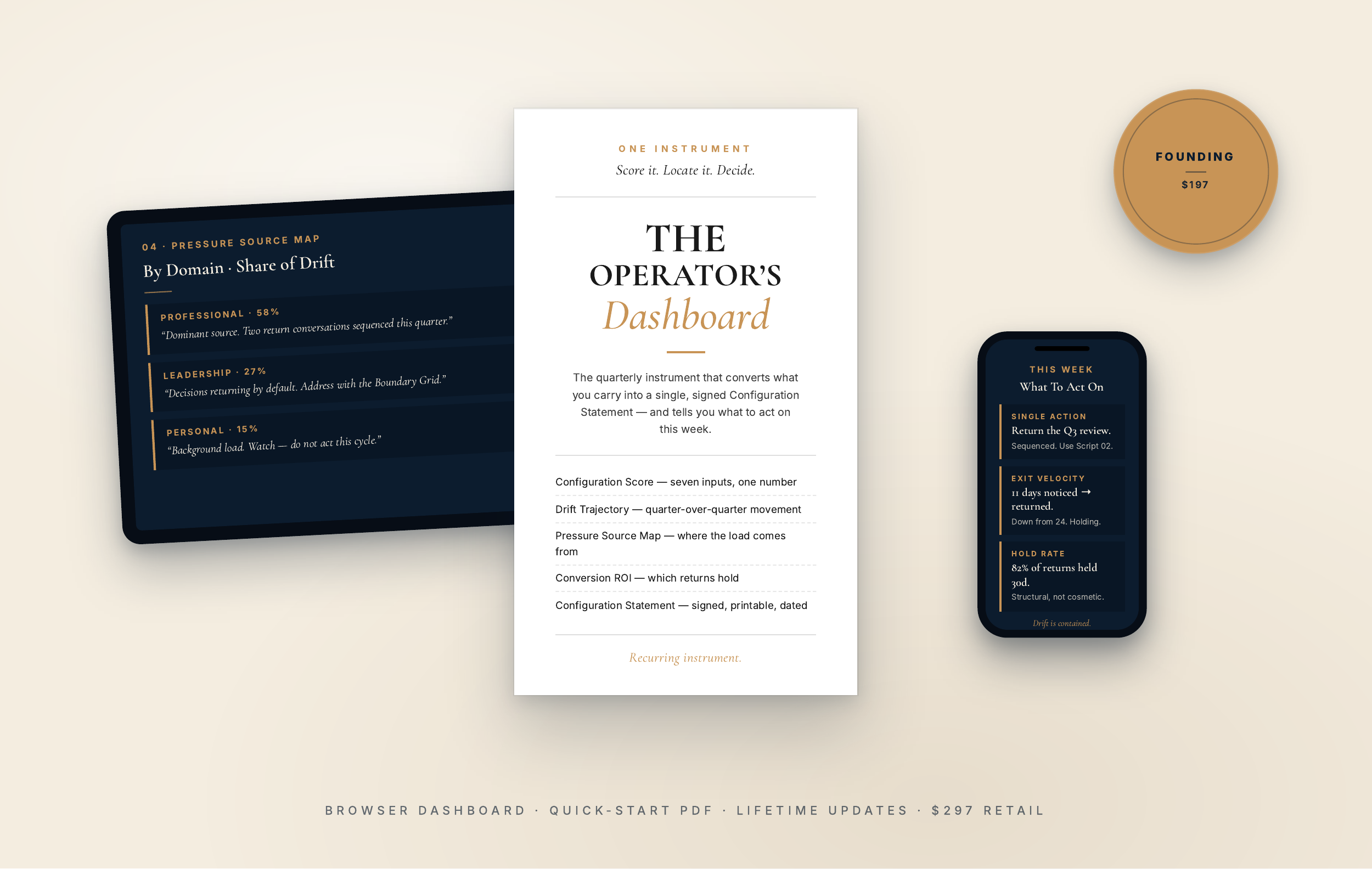
Drift is real.
It is also measurable.
Not a tracker. A quarterly instrument of record.
The Operator’s Dashboard is the quarterly companion to the work you’ve already done in the Clarity Reset System and the Responsibility Reclaim System. It does not measure activity. It measures configuration — the structural shape of what you carry, what is drifting, and where pressure originates.
Most dashboards count outputs. This one diagnoses load distribution and tells you exactly which conversation to have, this week, to keep the structure clean.
- 01Configuration Score
Seven inputs. One number. A weekly snapshot of how the structure is holding.
- 02Drift Trajectory
Quarter-over-quarter movement. Where load is migrating before it becomes a problem.
- 03Pressure Source Map
By domain — professional, leadership, personal. Where the load is actually coming from.
- 04Conversation ROI
Which return conversations held. Which didn’t. Pattern recognition for what works.
- 05Configuration Statement
A signed, printable, single-page summary of where you are. The artifact you carry into Q2.
- 06This Week
The single action this dashboard recommends — sequenced, scripted, ready to run.
For operators who’ve already done the work.
The Operator’s Dashboard is the recurring instrument that compounds what the CRS sets up and the RRS executes. If you’re still building the diagnostic vocabulary, start with the URF or the CRS first.
If you’ve worked the framework — if you can already name a misallocation in plain sentences and run the Boundary Decision Grid without notes — this is the next instrument. You’ll use it quarterly, for as long as you’re an operator.
“Drift is contained.”
WHAT IT TRACKS
Five inputs. One number. One decision per quarter.
- Configuration Score — seven inputs collapsed into a single number that tells you whether your operating posture is stable, drifting, or already overloaded.
- Drift Trajectory — quarter-over-quarter movement, so you can see the trendline, not just the snapshot.
- Pressure Source Map — where the load is actually coming from this quarter (professional / leadership / personal share).
- Conversation ROI — which returns from the last quarter held, and which were re-absorbed.
- Configuration Statement — a signed, printable one-pager you finish each quarter. The instrument of record.
WHY QUARTERLY
Quarterly is the operator interval.
Weekly trackers measure activity. Quarterly instruments measure structural posture — the thing that actually drifts and the thing weekly noise hides. A quarter is long enough for drift to show, short enough to course-correct before the next reset cycle is needed.
WHEN YOU USE IT
You don’t use OD to start. You use it to stay.
OD assumes you’ve already done a reset — typically via CRS and RRS. It’s the instrument that prevents you from re-absorbing what you just cleared. If you haven’t run CRS yet, start there. If you’re already past the reset, this is the recurring spine.
FIT CHECK
This is for a specific operator.
This is for you if —
- You’ve already done the reset work and want a structural way to check that it’s holding.
- You operate on quarterly cycles and want one instrument, not five dashboards.
- You’ve been burned by trackers that produce data without producing a decision.
This is not for you if —
- You’re at the start of overload. Run CRS first.
- You want daily or weekly accountability. OD is intentionally quarterly.
- You want coaching. This is an instrument, not a relationship.
QUESTIONS
Before you decide.
How long does it take each quarter?
About 45 minutes.
Do I need CRS or RRS first?
Not required, but designed to follow them. The dashboard scores postures the reset systems create.
Is it on my computer or hosted?
Browser-based instrument you own as a file on your device. No login, no account, no cloud. Quick-start PDF included.
What if my score gets worse?
That’s the signal. The dashboard tells you which reset system to re-run.
Keep the clearing.
The maintenance layer for operators who’ve already done the work.
Get the Operator’s Stack · $247 →